Oct 13, 2025
Introduction
Surimi, a refined fish myofibrillar protein paste, has been widely used across the world to make seafood products such as crab sticks, fish balls, fish sausages and many more.
As surimi products have become more and more popular over the years and now have a high global demand, maintaining the freshness and quality of surimi has now become one of the main things of surimi’s global trade.
With the demand for high quality even when travelling across continents, various efforts such as refrigeration, freezing, and appropriate packaging have become essential in ensuring that the quality of surimi products can be stable from the producers all the way to consumers.
Refrigerated Storage of Surimi
Refrigeration is one of the key aspects within the surimi industry. With refrigeration, surimi products are able to maintain their shelf life, which involves keeping their own texture, flavor, and safety intact.
With refrigeration, the global surimi industry is capable of maintaining the quality of surimi products throughout international shipping. This method has been leading surimi producers from all around the globe to fulfill the high global demand for surimi.
The average refrigerated surimi product shelf life, based on the distributed US supermarkets, is only 90-100 days.
During the production process, surimi products are normally chilled to around 4°C. This is considered a major step in the production process before finally getting surimi products packed in cartons.
The shelf life of surimi is mostly affected by the use of starches, even packaging materials.
As surimi production includes starches such as wheat, corn, potato, waxy maize, and tapioca, the shelf life of surimi products becomes shorter, which further causes their quality to decline more rapidly.
Similarly, the packaging of surimi products is also one of the key considerations to keep the shelf life stable as well as maintain its quality, especially from the shipping to retailing environment before the customer purchases the products.
Refrigeration, in this case, helps as a power protection for surimi products to keep their quality and shelf life. Refrigerated surimi products have more capability to avoid fishy odors that could come up from the growth of microbes during long transportation.
Frozen Storage of Surimi
Frozen storage has been considered more recommended compared to the refrigerated one for way longer distribution times. In this matter, the rate of the freezing method has a great influence on both the quality and shelf life of surimi products.
Frozen surimi products tend to have better capabilities in maintaining the good quality during long-term storage. Most surimi producers use a fast-freezing method to generate small ice crystals, which are more effective in helping surimi products avoid any damage to their quality than the large ones.
Other than that, the temperature of the storage is also an important aspect for longer distribution. With the usual temperatures set around -10°C to -20°C, 90% of moisture freezes, which influences the concentration of solutes in the remaining free liquid to increase approximately 10-fold.
Freezing time also plays a role in the quality of surimi products. It is recommended to adjust both the settings and the loading rate to make it steady at -34°C and chill the product before getting frozen to make it enter at around 4°C. This way, surimi producers can shorten the freezing times effectively.
Packaging and Storage Conditions
As mentioned, the packaging of surimi products is one of the major influences on their quality and shelf life.
Most of the surimi producers packed surimi products using vacuum packaging and the modified atmosphere packaging (MAP) to extend shelf life.
The shelf life of surimi seafood like Kamaboko is quite short, which is only one week if it is refrigerated. In this matter, vacuum packaging plays a major role in maintaining surimi's capability to extend its shelf life to 2-3 weeks long, only in the matter of its packaging itself.
Fun Fact: When the vacuum-packed products are pasteurized at 85°C internal temperature for around 15 minutes, surimi producers, especially those in the US, have been extending the shelf life effectively up to 90 days since 1989.
Ever since the early 2000s, the surimi industry has been reaching the 100 days of shelf life for the unopened vacuum-packed surimi products.
Storing Surimi at Home
Storing surimi at home might not be the easiest assignment to do for almost every consumer. However, as mentioned previously, surimi products must be stored either in refrigeration or in a freezer to maintain their own quality and avoid the growth of microbes.
1. Refrigerated surimi products
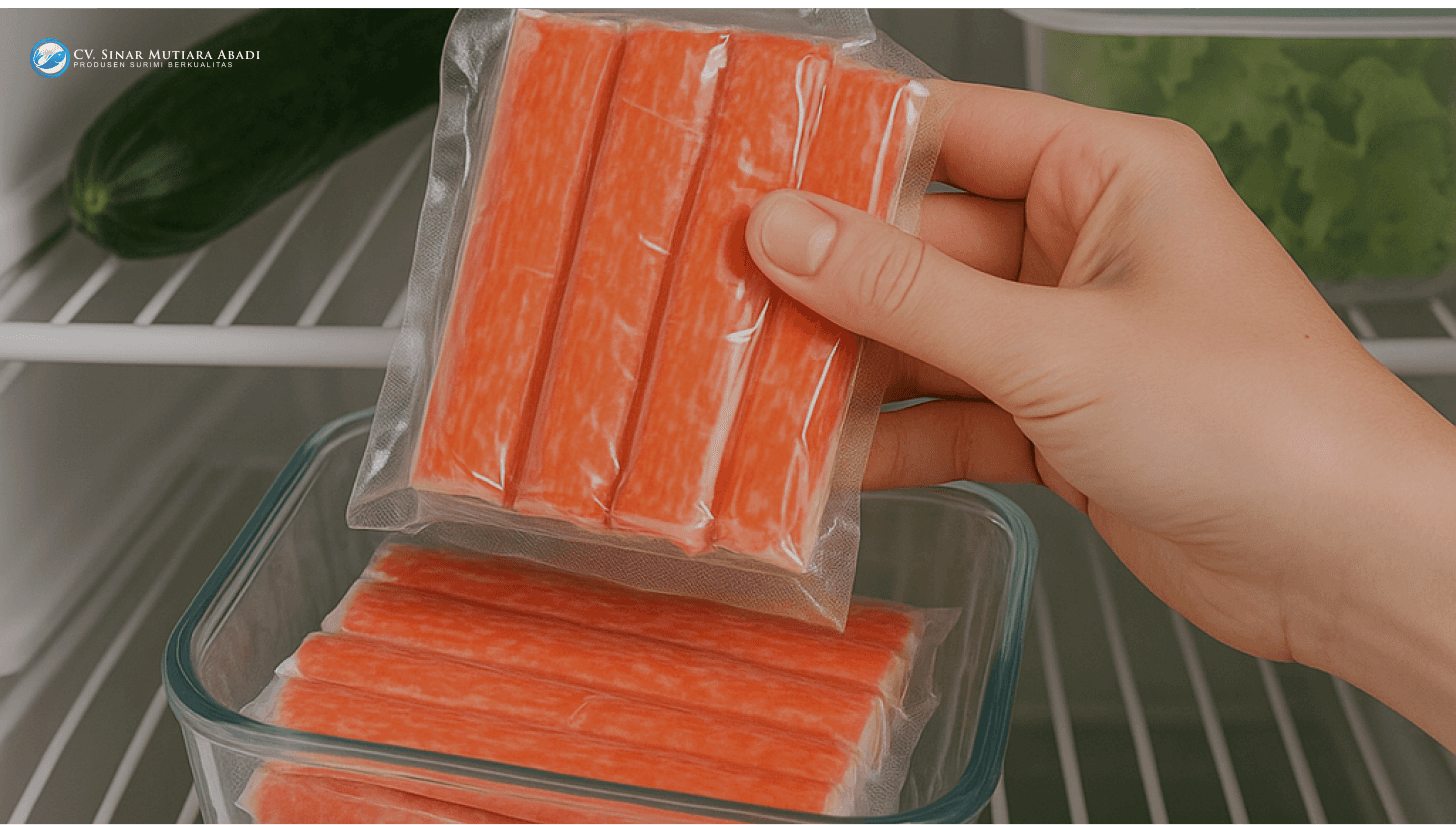
For a short term, it is recommended for customers to store surimi in refrigeration to extend surimi shelf life even after the products have been unsealed.
In the case of vacuum-packed surimi seafood products, it can also be stored under refrigerated storage below 3.3°C (38°F) to avoid the possibility of nonproteolytic types of C. botulinum growing and producing toxin.
The way to store surimi in a refrigerator varies quite a bit across the world. For instance, according to Trident Seafoods, surimi products like crab sticks and imitation lobster are better stored in the refrigerator between 32°F and 38°F.
Most surimi products would not survive being left out or stored at room temperature for more than two hours.
2. Frozen surimi products
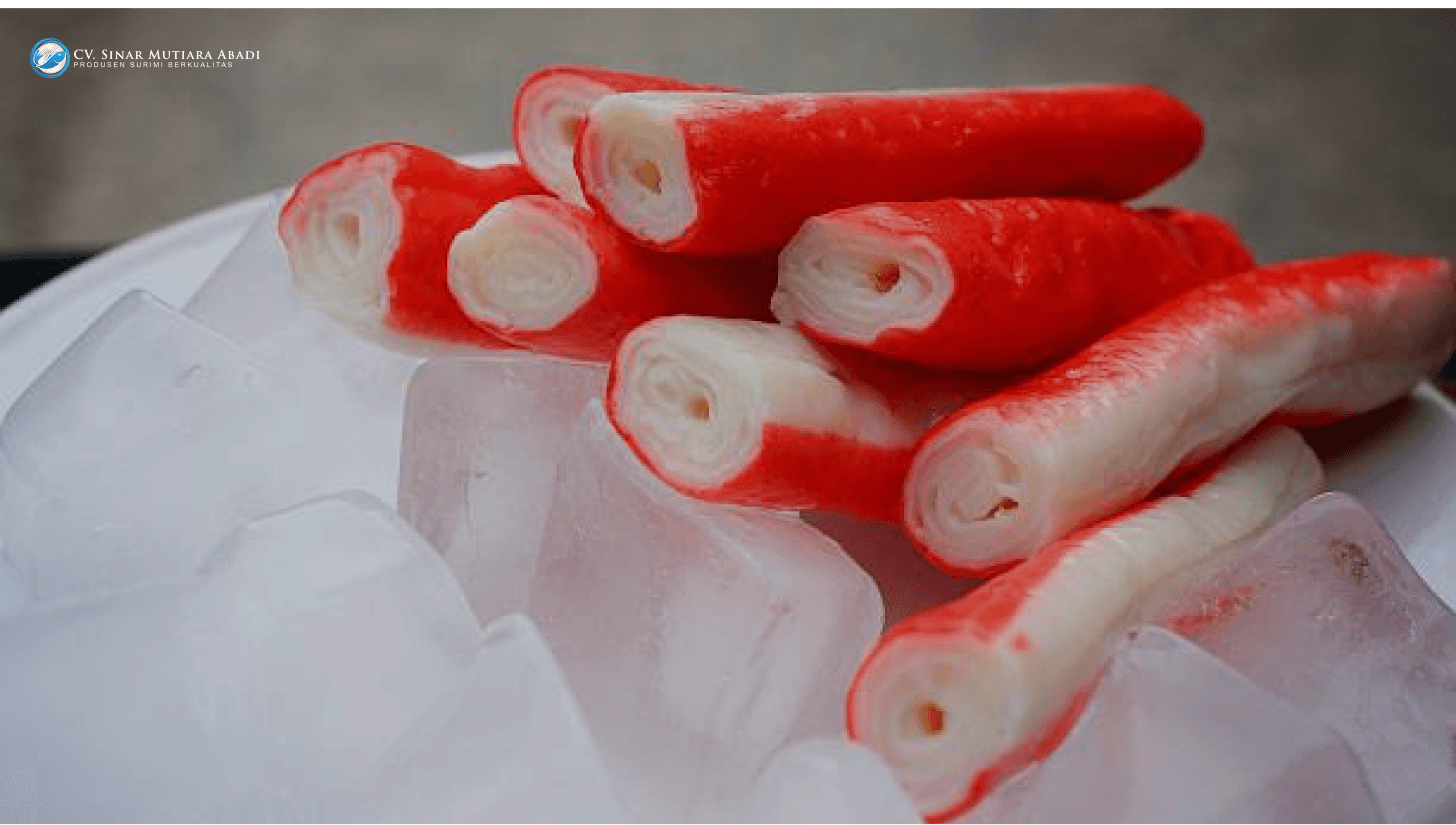
For long-term storage, a freezer is a better option to maintain surimi shelf life. Freezing is also recommended to store surimi safely at home, avoiding surimi products to get fishy odors.
However, thawed surimi products must not be refrozen to be used again. Other than that, freezing repeatedly, as mentioned by Zhao et al. (2024), could influence the growth of ice crystals and recrystallization. As a result, surimi products will then face a decline in their gel quality.
The most recommended temperature for freezing is to be steady at −34°C.
Industrial vs Household Storage
Many surimi producers use a mathematical model to freeze surimi products during the storing process. This model is obtained from the Plank equation, which has been assumed using a commercial freezer at −23°C at the beginning of the freezing cycle and then drops quite soon to −32°C.
During the production process, the velocity could increase to 5 m/s and cause the decreation of freezing time at around 2-1/2 h, which could also get to the level off at 1-1/4 h. This situation is considered not a good idea among surimi producers to produce air velocity because a lot of people have been contributing substantial heat to the system used.
However, both industrial producers and home users must keep in mind that the temperature for refrigeration and the freezing time are the two main factors that determine the duration of surimi shelf life.
Conclusion
On the whole, surimi shelf life depends on various factors, from how well the temperature is for the storage to their packaging throughout the production, distribution, and storage stages.
Both refrigerator and freezer play a major role in maintaining surimi shelf life for short- or long-term storage.
Storing surimi products properly has become a major contribution to their quality, which involves the flavors and texture as well as the safety of consumption.




Adress: Gajah Mada KM 4, Banyudono, Kaliori, Rembang 59252
Phone Number: +62 822 98989 169
E-mail: marketing@sinarmutiaraabadi.co